


Company flags with custom logo
Corporate flags of various designs and sizes for your company. High-quality materials and professional processing for every occasion.
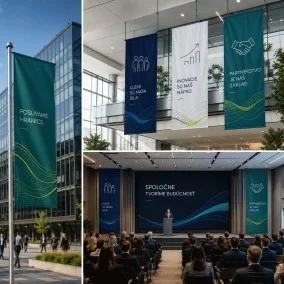
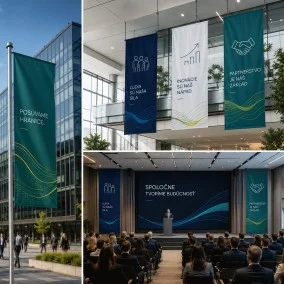
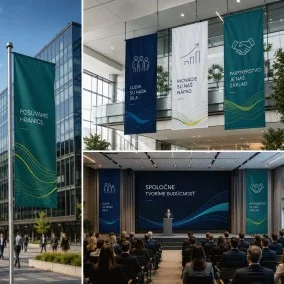
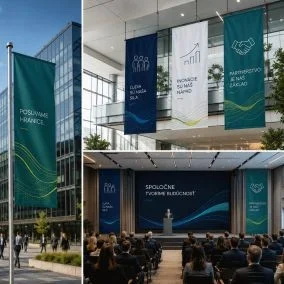
Corporate Flags as Part of a Professional Company Presentation
A corporate flag is a textile presentation element that serves to visibly mark a company, brand, or organization. It is most often placed in front of company headquarters, manufacturing facilities, retail outlets, car dealerships, administrative buildings, or at events, where it helps improve orientation and brand identification from a greater distance.
Unlike advertising banners, flags are designed to be easily readable even when moving in the wind. This is why both the graphic design and the choice of material, printing method, and pole construction play an important role.
Where Corporate Flags Are Most Commonly Used
In practice, we encounter them wherever it is necessary to increase the visibility of a company or mark a specific location. Often, it is a long-term outdoor solution that operates continuously without the need for electricity or maintenance.
- in front of administrative buildings
- in manufacturing and logistics areas
- at shopping centers and stores
- at trade fairs and exhibitions
- during corporate and sports events
- at grand openings of establishments
In larger industrial zones, the flag is often the first identifying element by which a visitor finds a specific company even before seeing the actual building.
Materials Used for Manufacturing Corporate Flags
The most commonly used material is polyester flag fabric with a weight of approximately 110 to 155 g/m². This material is light enough for natural movement in the wind and is also resistant to UV radiation, rain, and regular mechanical stress.
For long-term outdoor use, the quality of the edge stitching and the method of attachment are very important. These details determine how long the flag will last without damage. In practice, wear is most often visible at the outer corners, not on the print itself.
The Difference Between a Corporate Flag and an Advertising Banner
Although these terms are often confused, they are not the same products. A classic corporate flag is usually hoisted on a pole and has a rectangular shape. An advertising banner is typically equipped with a flexible structure and is made in the shape of a drop, feather, or rectangle with a tensioning system.
For permanent establishments, classic pole flags are most commonly used. At exhibitions, promotional events, or short-term occasions, advertising banners are used, which can be easily relocated.
How to Choose a Corporate Flag
The most important factor is not the size itself, but the place of use. The requirements for a flag on a busy road differ from those in front of an administrative building in the city center.
When choosing, it is worth considering:
- the height of the pole
- the distance from which the flag will be visible
- the wind conditions in the area
- the frequency of graphic changes
- the expected lifespan
- the method of attachment and pole maintenance
A common mistake is overly detailed graphics. Logos or slogans that look good on a monitor may be unreadable from several dozen meters away. Simpler designs work significantly better for flags.
Why Companies Invest in Quality Flags
A corporate flag is one of the elements that works continuously and requires no maintenance. From a visitor's perspective, it creates a first impression even before entering the building and helps build the professional identity of the company.
In a corporate environment, it is often used to mark multiple brands belonging to one group, to navigate visitors in extensive areas, or to visually separate individual establishments. With the right design, a flag can serve for several years without the need to replace the entire structure.
It provides the greatest value in locations with high foot or vehicle traffic, where it ensures constant visibility for the company without additional operating costs.