


Table flags and stands
Table displays and stands for effective product presentation. Quality materials and modern design for every store.

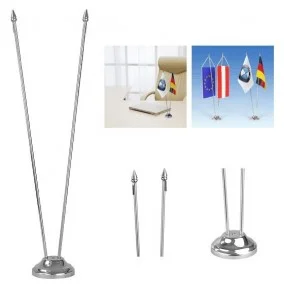
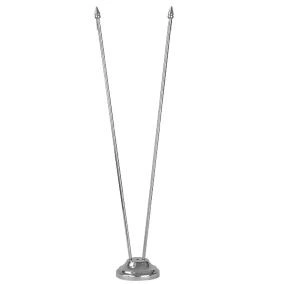
Table Flags You Will Find at Meetings, Receptions, and International Gatherings
Table flags are among the most commonly used representative elements in administrative spaces. They are utilized in business meetings, conferences, receptions, contract signings, international negotiations, and in public institutions. Despite their small size, they can clearly identify an organization, country, or business partner.
The standard size of a table flag is 11 × 16 cm, providing good visibility on the conference table without obstructing the view between meeting participants.
Why Satin Material is Used for Table Flags
The flags are made from PES satin material called Satinnete, which is used primarily where a representative presentation of colors and details is important. The satin surface creates a subtle sheen, making state emblems, logos, and color areas more pronounced than with regular textile materials.
The material also holds its shape well and looks elegant even with everyday use in an office environment. The flag is edged with a white twisted cord, giving the product a traditional appearance known from diplomatic and protocol settings.
Where Table Flags are Most Commonly Used
In practice, they can be found wherever it is necessary to mark the represented country, organization, or partner. Their significance is not merely decorative. They help create a clear and professional environment during formal meetings.
- company meeting rooms,
- city and municipal offices,
- ministries and state organizations,
- embassies and consulates,
- hotels and conference centers,
- schools, universities, and international projects.
At international meetings, a common combination is the flag of the Slovak Republic and the flag of the partner country or the European Union.
How to Choose the Right Stand
The choice of stand affects not only the appearance but also the stability of the entire assembly. For everyday use, it is important that the flag stands upright, does not tip over, and withstands regular handling on the table.
Wooden Stand
The wooden version is one of the classic solutions suitable especially for traditional offices, historic buildings, or representative spaces. The height of 39 cm ensures good proportions with the standard flag.
Metal Stand
The metal version appears more modern and is often used in administrative buildings and meeting rooms. The higher weight of the base improves stability during handling.
Spiral and Pointed Design
These models are chosen primarily based on the interior design. The difference is not primarily in function but in visual processing and the overall impression they create on the conference table.
Telescope Stand
The telescopic version offers the greatest flexibility. The height can be adjusted from 28.5 cm to 50 cm, allowing for the use of larger flags than the standard size of 11 × 16 cm.
In practice, this is a solution often used by event organizers or institutions working with multiple flag formats. The advantage is an all-metal construction, anti-corrosive treatment, a soft protective pad to prevent scratching tables, and a top fixing element that keeps the flag in the correct position.
A Decision Factor That is Often Overlooked
Many focus solely on the flag itself when choosing, but for everyday use, the stand is often more important. Poor-quality or too-light bases can tip over during handling, making the flag appear unrepresentative.
In receptions, meeting rooms, or places with frequent movement of people, it is therefore worthwhile to choose a more stable metal or telescopic version. The difference in comfort of use is often more significant than the difference in appearance.
Why Organizations Still Use Table Flags Today
Even in the digital environment, table flags remain an important part of protocol and representation. They help identify meeting participants, emphasize the international character of gatherings, and create a professional environment without the need for additional markings.
For this reason, they remain a common part of diplomatic meetings, business negotiations, conferences, and the representative spaces of public institutions.