


Flagpoles
Flagpoles for companies, offices, schools, hotels, or events – a durable, representative, and practical solution for showcasing a brand, building, or event. A selection for every space.
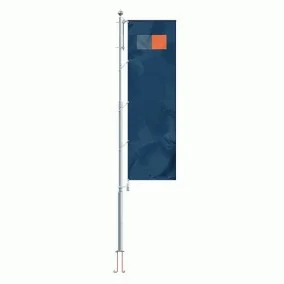
Flagpoles with a rotating arm and internal cable
Show products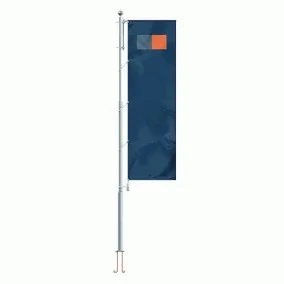
Flagpoles with a rotating arm, internal cable, and crank
Show products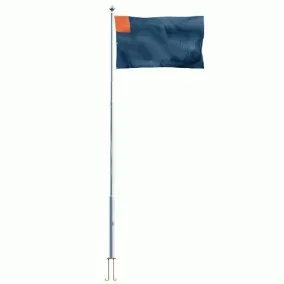
Flagpoles basic with external rope
Show products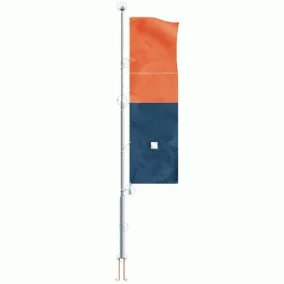
Flagpoles with internal halyard
Show products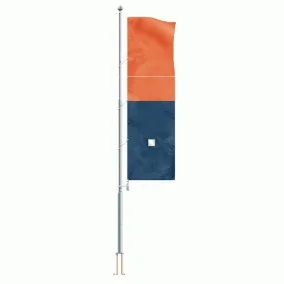
Flagpoles with internal halyard and winch
Show products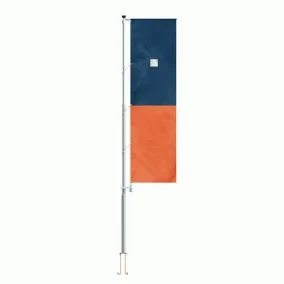
Flagpoles with a rotating arm without a rope
Show products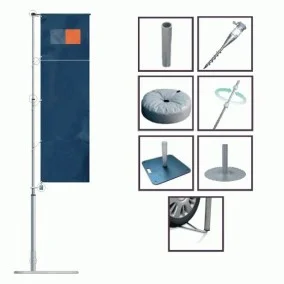
Mobile telescopic flagpoles
Show products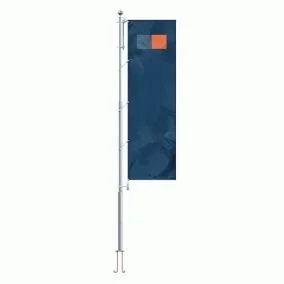
Flagpole as part of the first impression: where it makes sense and how to choose
The flagpole is one of the elements that visitors notice even before entering the building. Therefore, it is used not only for displaying national, corporate, or advertising flags but also as a directional and representative point in the exterior. With the right height and placement, it can highlight the company's headquarters, hotel, school, sports complex, or public building without the need for additional advertising elements.
In practice, aluminum poles with heights ranging from 6 to 12 meters are most commonly used. Aluminum is resistant to corrosion, does not require regular painting, and maintains stability and appearance over long-term use. For larger buildings or extensive areas, poles with heights of 14 to 18 meters are often installed to ensure the flag is visible from a greater distance.
What type of flagpole is most commonly used
The choice mainly depends on the frequency of flag handling, safety requirements, and the nature of the space.
Poles with external rope
This is the simplest solution, where the rope is guided along the outside of the pole. The advantage is lower acquisition costs and a simple structure. They are mainly used where the pole is located in a closed or monitored area.
Poles with internal rope
The rope is guided inside the pole, protecting it from damage, vandalism, and weather influences. This type is often installed in front of administrative buildings, hotels, offices, and schools, where emphasis is placed on a representative appearance.
Poles with a crank mechanism
Handling the flag is more convenient, especially with taller poles. The crank system allows for precise tensioning of the rope and easy lowering of the flag without the need for intervention at height.
Poles with a rotating arm
The rotating arm keeps the flag spread out across its entire height even in light winds. This system is popular for corporate and advertising flags, where it is important for the logo or graphics to be readable throughout the day.
Telescopic mobile poles
A mobile solution designed for exhibitions, sports events, presentations, or seasonal activities. The advantage is easy transport and assembly without the need for a permanent foundation.
Why companies invest in quality poles
The flag itself has a significantly shorter lifespan than the pole. Therefore, in professional installations, the long-term reliability of the supporting structure is primarily addressed. A quality pole can serve for decades, during which only the flags are changed.
In the business environment, one factor is often underestimated — maintenance costs. Cheaper solutions may require more frequent replacements of pulleys, ropes, or fastening elements. In buildings with high foot traffic, maintenance interventions are often more expensive than the difference in acquisition cost of a higher-quality system.
From a facility management perspective, wind resistance is also crucial. In open industrial zones, near logistics centers, or in hilly locations, it is necessary to choose poles designed for higher wind loads and to properly dimension the foundation anchoring.
Where flagpoles are most commonly used
- in front of administrative buildings and company headquarters,
- at hotels, guesthouses, and conference centers,
- in schools, universities, and public institutions,
- in sports complexes and recreational centers,
- at exhibitions, trade fairs, and corporate events,
- in industrial and logistics parks,
- in squares, near cultural sites, and memorials.
How to choose the right height for the pole
The height should correspond to the surrounding architecture. For single-story buildings, poles around 6 to 8 meters are often used. Common heights in front of administrative buildings are 8 to 12 meters. For extensive areas or buildings near main roads, taller structures are utilized.
It is also important to consider the size of the flag. A flag that is too small on a tall pole appears unbalanced, while an excessively large flag increases the wind load on the structure. Therefore, the size of the flag is always designed in relation to the height of the pole and local weather conditions.
What determines the lifespan of a flagpole
The greatest influence comes from the quality of the material, the anchoring method, and the wind load. Modern aluminum poles with anodized surfaces resist corrosion even without regular maintenance. With a properly designed foundation and quality internal mechanisms, it is an investment that can last several decades.
In practice, the most common cause of problems is not the pole itself but improperly designed anchoring or the use of an inappropriate flag size for the location. Therefore, it is worthwhile to address the choice of pole along with the assessment of the installation site, not just based on price or height of the structure.