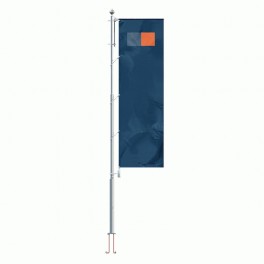
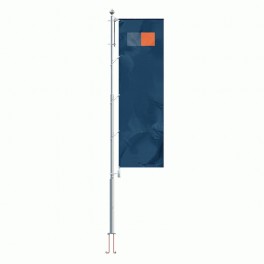
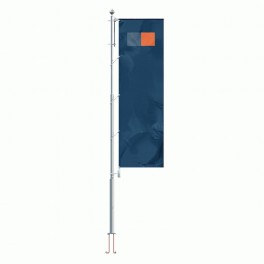
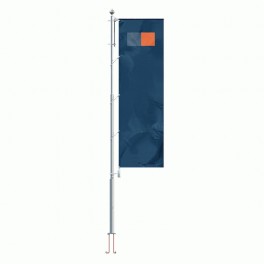
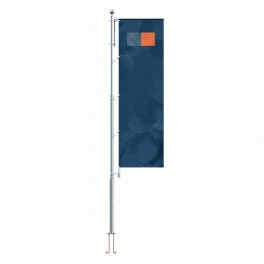
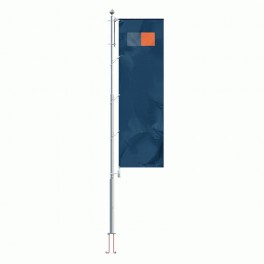
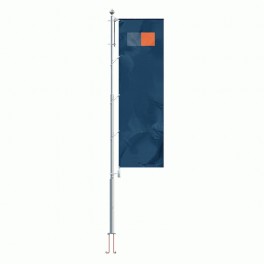
Flagpoles with a rotating arm, internal cable, and crank for easy operation and an elegant appearance in your outdoor decor.
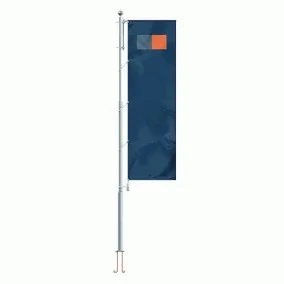
Flagpole with Rotating Arm and Crank: When Emphasis is Placed on Comfortable Handling and Representative Appearance
In buildings where flags are changed regularly or used throughout the year, not only the pole itself but also the method of controlling the flag system plays an important role. A flagpole with a rotating arm, internal cable management, and a crank mechanism is among the most comfortable solutions for everyday operation.
It combines three features that are most often required in professional installations. The flag remains fully unfurled and visible, the controls are hidden inside the pole, and changing the flag is easy even at greater heights of the structure.
How it Differs from a Pole with Classic Internal Cable Management
The main difference is the integrated crank mechanism. Instead of manually pulling the cable, the flag is controlled using a winding system located inside the pole. The operation is smooth and precise without the need to handle loose cables.
In practice, this difference is most noticeable in poles with heights of 8, 10, or 12 meters. With regular lowering and raising of the flag, working with the crank is significantly more comfortable and allows for more precise tensioning of the system.
Why a Rotating Arm is Used
A standard flag reacts to the direction and intensity of the wind. If the wind dies down, the material often wraps around the pole, and the graphics become invisible. The rotating arm, 160 cm long, keeps the top of the flag spread out, and the rotating head naturally adjusts to the wind direction.
The result is a consistently visible motif regardless of current weather conditions. This feature is particularly important for corporate, advertising, and presentation flags, where the readability of the graphics is a priority.
Advantages of Internal Cable Management
All moving parts are located inside the pole. The cable is protected from rain, UV radiation, and mechanical damage, and it does not produce the typical sound of hitting the pole profile during windy weather.
For representative buildings, this is a significant detail. Internal cable management creates a cleaner appearance of the structure and reduces the risk of unauthorized interference with the control system.
Who Benefits Most from the Crank Mechanism
The greatest benefit is for buildings where flags are changed multiple times a year or where seasonal campaigns, advertising motifs, or various national and corporate flags are used.
- administrative buildings and company headquarters,
- hotels and convention centers,
- city and municipal offices,
- schools and universities,
- exhibition centers and fairgrounds,
- sports centers and stadiums,
- commercial and logistics parks.
Building managers often choose the crank system because it reduces the time needed to handle the flag while minimizing wear on mechanical parts during regular use.
Aluminum Construction for Long Lifespan
The pole is made from anodized aluminum profiles. Anodizing creates a protective layer that increases resistance to corrosion, moisture, and common atmospheric influences.
Aluminum poles have a lower weight compared to steel solutions, making them easier to handle during installation and requiring minimal maintenance. This is why they are used in most modern professional installations.
How to Choose the Right Height of the Pole
Models are available in heights from 5 to 12 meters. Smaller poles, 5 or 6 meters tall, are used at building entrances, in parking lots, or in smaller areas.
The most common choice for companies is heights of 7 to 10 meters, which provide good visibility without appearing disproportionate to the surrounding architecture. Twelve-meter poles are primarily used for large buildings or in locations where visibility from a great distance is necessary.
When choosing the height, the size of the flag should also be considered. The rotating arm, 160 cm long, can be shortened if a narrower flag format is used.
Installation and Anchoring
The pole is installed into a prepared concrete base using a fixed or folding base. For the tallest models, a folding base is a practical solution for future servicing or checking mechanisms.
In professional practice, the importance of the foundation is often underestimated. Properly designed anchoring has a greater impact on the stability of the entire assembly than the thickness of the profile or the type of mechanism.
Why It Is Among the Most Used Professional Solutions
A flagpole with a rotating arm, internal cable management, and a crank combines three features that companies and institutions most often demand: continuous visibility of the flag, easy handling, and long-term reliability.
For buildings where the flag is part of the corporate identity or representation of the organization, it represents a more comfortable and technically advanced solution than basic models with manual control.