


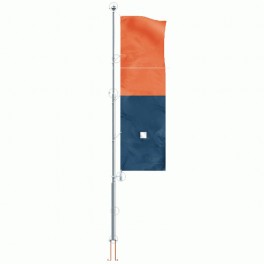
Flagpole with internal rope, height 5 m
Flagpole with internal rope, 5 meters high, aluminum, theft-resistant, easy flag replacement
264,30 €
(325,09 incl. VAT)
Product detail● Regularly in stock
Flagpoles with internal rigging are ideal for elegant and secure display of your flags. Quality materials and modern design.
Flagpole with internal rope, 5 meters high, aluminum, theft-resistant, easy flag replacement
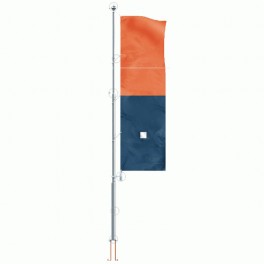
Flagpole with internal halyard, 6 meters high, aluminium, theft-proof, easy flag replacement
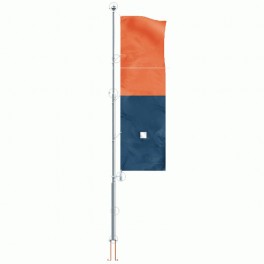
Flagpole with internal cable, 7 meters high, aluminum design, theft protection, easy flag replacement.
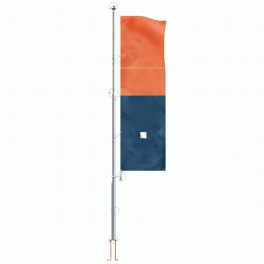
The flagship pole with an internal halyard, 8 meters tall, secures the flag against theft and allows easy replacement.
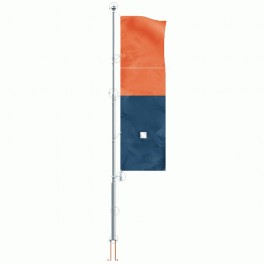
Flagpole with internal cable, 9 meters high, aluminum, safe flag replacement, elegant mounting and stable anchoring.
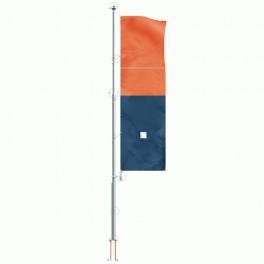
Flagpole with internal halyard, 10 meters tall, made of aluminum, secure flag attachment, easy to change.
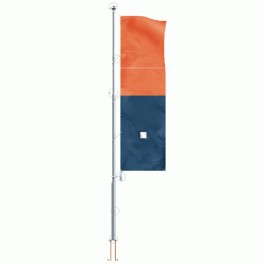
Flagpole with internal cable, 12 meters high, made of aluminum, theft-proof, easy flag replacement
When choosing a flagpole, one often decides between a simple external halyard and a more modern internal system. Although both types serve the same function, they differ in terms of protection, aesthetics, and usability. A pole with an internal halyard is a solution for locations where, in addition to the presentation of the flag itself, emphasis is placed on safety and a representative appearance.
The internal halyard conceals the control mechanism inside the structure, protecting the halyard from weather influences and unauthorized manipulation. For this reason, it is one of the most commonly used solutions for administrative buildings, schools, hotels, and public institutions.
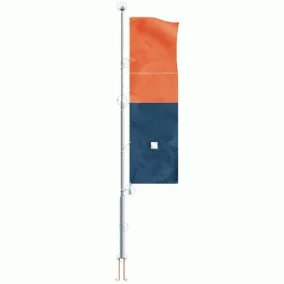
This is a pole where the flag halyard is located inside the aluminum profile. The control system is secured with a nylon clamp and covered with a cap fastened with hex screws.
Unlike external systems, the halyard is not freely accessible. This significantly limits the possibility of theft of the flag or interference with the mechanism by unauthorized persons.
The greatest advantage is the combination of protection and aesthetics. There are no visible freely hanging ropes or fastening elements on the pole, which makes the entire structure appear cleaner and more professional.
In environments with high visitor traffic, protection against manipulation is also important. Schools, offices, or hotels often address the safety of the flag system, as the external halyard can be easily accessible.
A practical advantage is also the lower wear of the halyard itself. The halyard is not exposed to UV radiation, rain, or wind to the same extent as with external systems.
Despite the internal halyard, manipulation remains simple. When replacing, it is not necessary to tilt or disassemble the pole. It is enough to manually lower the halyard, detach the original flag, and attach the new one.
The flag is tensioned using a weight located at the bottom. Stable tension helps to limit the tangling of the material and reduces stress on the attachment points during windy weather.
A pole with an internal halyard provides protection for the mechanism but does not include a rotating arm. Therefore, the position of the flag remains dependent on the direction and intensity of the wind.
If the priority is to have a constantly visible logo or advertising motif, a pole with a rotating arm is a more suitable solution. If the main requirements are safety, simple operation, and a representative appearance of the pole, an internal halyard is often the optimal choice.
In many cases, it is a compromise between a basic pole with an external halyard and more expensive systems with rotating arms or crank controls.
The pole is made of anodized aluminum profiles. The anodized surface creates a protective layer that increases resistance to corrosion and reduces maintenance requirements.
Compared to steel constructions, it does not require regular protective coatings and retains its appearance even with long-term outdoor use.
Poles are available in heights from 5 to 12 meters. Smaller models with a height of 5 or 6 meters are used at building entrances and on smaller plots.
The most common choice for companies and public institutions is heights of 7 to 10 meters. Twelve-meter poles are particularly useful in large areas or in places where good visibility from a greater distance is required.
When choosing the height, one should also consider the size of the flag and the character of the surrounding buildings. A pole that is too high next to a low building may appear unbalanced, while one that is too low may not provide sufficient visibility.
The pole is installed using a fixed or tilting base into a prepared concrete foundation. Properly designed anchoring has a fundamental impact on the stability of the structure during strong winds.
For taller models, a tilting base is often used, which simplifies any maintenance or technical inspection without the need for special lifting equipment.
A pole with an internal halyard represents a balanced compromise between price, safety, and appearance. It provides greater protection than basic models with external halyards while maintaining simple operation without complex mechanics.
For this reason, it is one of the most frequently installed poles at buildings where the flag has a representative function and reliable operation is required throughout the year.