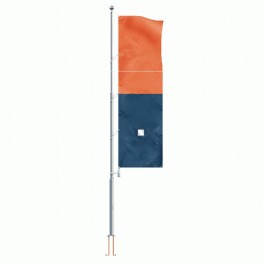
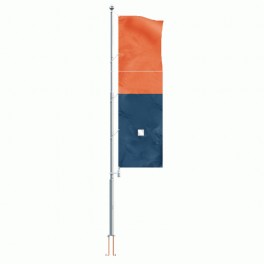
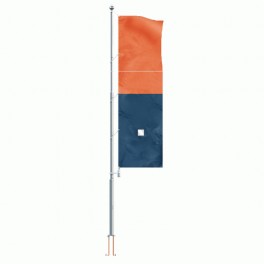
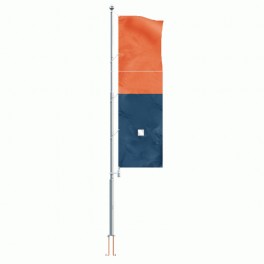
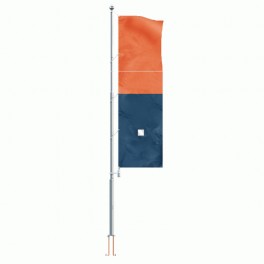
Flagpoles with internal halyard and winch, ideal for elegant flag display. High quality and easy handling for everyone.
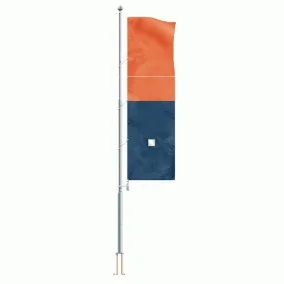
Flagpole with internal rope and crank: convenient handling without compromising safety
In locations where flags are changed regularly or used throughout the year, not only the construction of the pole itself becomes important, but also the method of operating the flag system. This is why poles with internal ropes and cranks are among the most practical solutions for companies, hotels, schools, offices, and representative buildings.
The internal guidance protects the rope from damage and unauthorized handling, while the crank mechanism significantly simplifies daily operation. The result is a safe, quiet, and comfortable system suitable for taller poles.
What is a flagpole with internal rope and crank
It is an aluminum segmented pole in which the flag guidance is housed inside the structure. The operation is carried out using a winding mechanism with a crank, which allows for lowering and raising the flag without direct manipulation of the rope.
The mechanism is secured against unwanted interference and simultaneously protects the flag from easy theft. Compared to traditional external guidance, it is a significantly more sophisticated solution designed for long-term operation.
Why the crank system is mainly used for taller poles
At heights of 8, 10, or 12 meters, manually lowering the flag guidance can be less comfortable. The crank allows for precise and smooth control without much physical effort.
In practice, the difference is most noticeable during regular flag changes. Hotels, city offices, or companies often use multiple flags throughout the year, and the crank system significantly speeds up their exchange.
Another advantage is the more precise tensioning of the flag and less strain on the guidance itself during handling.
What advantages does internal rope guidance bring
Internal guidance is among the most sought-after solutions in professional environments. The rope is not exposed to wind, rain, or UV radiation to the same extent as in external systems.
At the same time, the typical clattering of metal parts against the pole during windy weather is eliminated. This is why these models are often installed at hotels, office buildings, or residential projects, where noise can be undesirable.
- higher protection against flag theft,
- cleaner appearance without visible rope,
- lower wear on the mechanism,
- quieter operation during wind,
- easier handling during flag changes.
How flag exchange works in practice
During the exchange, it is not necessary to disassemble or tilt the pole. The operator uses the crank to lower the flag guidance to the required height, replaces the flag, and then raises it again.
The flag is tensioned by a weight located at the bottom of the system and secured using POE mounts. This solution helps keep the material taut and reduces the risk of tangling in stronger winds.
When to choose a crank and when manual control is sufficient
For shorter poles with occasional flag changes, traditional internal guidance without a crank is often sufficient. However, if frequent handling occurs or if the pole is taller than approximately 8 meters, the crank mechanism provides significantly higher comfort.
The deciding factor is often not the height of the pole itself, but the frequency of flag changes. This detail is often underestimated when purchasing.
The difference between a pole with a crank and a pole with a rotating arm
The crank mechanism addresses the method of operating the flag. The rotating arm addresses the method of presenting the flag.
With a pole with a crank, the display of the motif remains dependent on the wind. If the goal is continuous visibility of a logo or graphic, a model with a rotating arm is often a more suitable solution.
In practice, decisions are often made between the convenience of operation and maximum visibility of the advertising or corporate motif.
Aluminum construction for year-round use
The pole is made of anodized aluminum profiles, which provide high resistance to corrosion and weather effects. The anodized surface does not require regular protective coatings and maintains a representative appearance even after years of use.
It is precisely the combination of low weight, strength, and minimal maintenance requirements that makes aluminum the most commonly used material in modern flagpoles.
What height of pole to choose
Models are available in heights ranging from 5 to 12 meters. Smaller poles are used in front of building entrances or on smaller plots. Heights of 7 to 10 meters represent the most common choice for corporate headquarters, schools, and public institutions.
Twelve-meter poles are primarily used in industrial areas, logistics centers, or places where visibility from a greater distance is required.
Who is the flagpole with internal rope and crank the best choice for
This type of pole is intended for users who want to combine the safety of internal guidance with convenient daily operation. It is most commonly used at buildings where flags are changed regularly and where a professional appearance of the entire space is important.
Compared to simpler models, it represents a higher investment that pays off mainly in easier operation, lower wear on the mechanism, and higher comfort during handling throughout the pole's lifespan.