


Flags with custom printing
Banners with custom printing for every occasion. Quality materials and unique designs tailored to your needs. Ideal for your events and presentations.
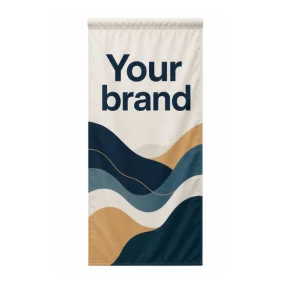
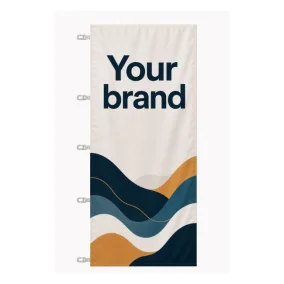

Custom Printed Flags: When a Brand Needs to Function in Space, Not Just on Paper or Screen
Custom printed flags are textile carriers of visual identity used both outdoors and indoors. Unlike static advertisements, they interact with wind, movement, and distance, significantly affecting how they are perceived. Therefore, their design addresses not only the graphics but also the behavior of the material in real conditions.
What a Custom Printed Flag Means in Practice
It involves the production of a flag according to a provided or modified design. This can include a logo, color identity, symbol, or a combination of elements that represent a company, municipality, or organization.
In practice, the design is often adjusted because the flag is not presented in a static form. The wind constantly changes it, and the visual must work in various stages of unfolding.
How a Flag Behaves in Real Environments
A flag is a dynamic object. Its readability changes according to the wind, angle of view, and distance. A logo or text may be completely legible at one moment and hidden by a fold of fabric a second later.
Therefore, the design is not made just for an ideal state but for situations when the flag is partially folded or in motion. In practice, this means that important elements must be larger and visually dominant.
Material and Production Determine How Long a Flag Lasts
The most commonly used material is polyester flag fabric with a weight of approximately 110 to 160 g/m². The material must be lightweight to work with the wind but also strong enough to withstand long-term stress.
The printing method affects the longevity of colors and the overall visual impression. For outdoor use, UV stability is crucial because fading colors mean a loss of identity even when the fabric is physically undamaged.
- UV-resistant and colorfast printing,
- air permeability to reduce wind load,
- strong edges and reinforced seams,
- accurate preservation of corporate colors,
- the possibility of producing various sizes according to the pole or use.
What Determines Whether a Flag Works in Practice
The most common mistake is an overcrowded design. A flag is not a space for detailed communication but for quick identification from a distance. Simplicity, contrast, and a clear silhouette work best in practice.
Placement also plays a significant role. The same flag appears differently in an open space and in an urban environment, where wind and light change its behavior.
Another factor is the height of the pole – the higher the flag is placed, the fewer details are readable for a person on the ground.
Why Flags Are Used in B2B Practice
A flag is one of the few advertising elements that works without active attention. It does not require interaction or proximity – it just needs to be part of the space.
In practice, it is used to mark company headquarters, entry zones, sales points, or events, helping with orientation and creating a visual identity for the space.
When Custom Printing Makes the Most Sense
The greatest benefit comes when a consistent visual identity is needed across multiple locations. Flags can be reproduced identically, ensuring a uniform visual impression.
In practice, the repeatability of production is also important – a well-prepared design allows for the production of additional pieces without deviations in colors and proportions.