


EU flags
EU flags in various sizes and designs. Quality materials for every occasion. Choose the ideal flag for your needs.
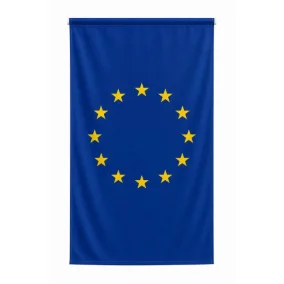
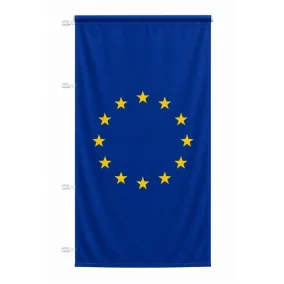
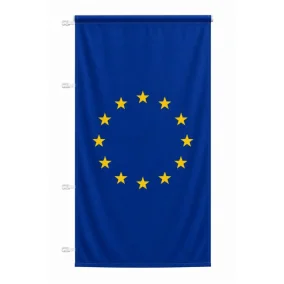
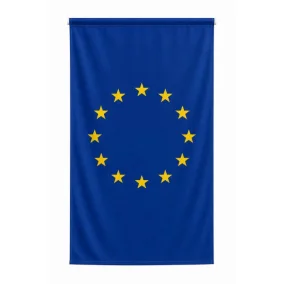
European Union Flag for Buildings, Masts, and Representative Spaces – How to Choose the Right Version
The European Union flag is one of the most commonly used symbols on public administration buildings, schools, universities, cultural institutions, and in the private sector. Unlike traditional flags, banners are often used on building facades, brackets, or special mast systems, where they remain more visible even in light winds.
When choosing, not only the size is important, but especially the method of attachment. This affects the appearance of the flag, its behavior in the wind, ease of hoisting, and overall lifespan.
What is the Difference Between a Flag and a Banner
A banner is a textile symbol designed primarily for fixed or partially fixed attachment to a pole, bracket, or facade system. Unlike a traditional flag, its presentation does not have to depend solely on the wind.
In practice, banners are used where it is necessary to maintain good visibility of the symbol throughout the day. A typical example includes government buildings, schools, diplomatic institutions, or representative entrances to administrative buildings.
Banner with a Sleeve – The Most Common Solution for Facades and Brackets
The sleeve represents a reinforced textile tube placed on the short side of the banner. It serves to slide onto a pole or bracket.
This method of attachment ensures a stable position of the banner and an even distribution of load across the entire width of the attachment. It is mainly used on buildings where the banner is displayed for a long time and does not require regular lowering.
Available sizes range from 60 × 90 cm to 150 × 300 cm, allowing use from interior stands to large administrative buildings.
Banner with Carabiners – A Solution for Mast Systems
Carabiners are designed to attach the banner to a rope or lifting mechanism of the mast. The banner is attached on the long side, ensuring it remains properly oriented during hoisting.
The advantage of the carabiner system is easy handling. The banner can be quickly hoisted, lowered, or replaced without interfering with the mast's structure.
In the environment of towns, municipalities, schools, and corporate campuses, this is the most commonly used method of attachment for daily operations.
Combination of Carabiners and Sleeve – When Maximum Stability is Required
A banner equipped with both carabiners and a sleeve combines the advantages of both systems. Carabiners ensure attachment to the mast system, while the sleeve allows for additional guidance or tensioning using an arm.
This solution is primarily used for advertising and representative masts, where it is important to maintain the readability of the motif even in calm weather.
In practice, this is a version that is often chosen for public buildings, embassies, universities, or projects funded by European programs.
Why Dispersion Printing is Important for Banners
Dispersion printing is one of the most reliable technologies for producing outdoor banners. The color penetrates directly into the polyester fibers, ensuring good visibility of the motif from both sides.
The advantage is the low weight of the material, natural movement in the wind, and even color representation. For large sizes, low weight is one of the factors that significantly reduces the load on the structure.
The Importance of Double Stitching for Long-Term Use
The edges are among the most stressed parts of any banner. Double stitching around the perimeter helps withstand friction, vibrations, and repeated loads caused by the wind.
Experience shows that the quality of the seams often has a greater impact on lifespan in outdoor use than the thickness of the fabric itself.
How to Choose the Right Size
The size of the banner should correspond to the installation location and the distance from which it will be observed.
- 60 × 90 cm – interiors, smaller brackets, and entrance spaces.
- 80 × 120 cm – smaller buildings, schools, and municipal offices.
- 100 × 150 cm – universal size for most administrative objects.
- 100 × 200 cm – suitable for higher facades and larger brackets.
- 150 × 225 cm – representative buildings and larger masts.
- 100 × 300 cm and 150 × 300 cm – objects requiring high visibility.
- 150 × 400 cm – large open spaces, squares, and significant public buildings.
For larger sizes, it is advisable to consider local wind conditions. In exposed locations, it may be wiser to use a smaller size with a longer lifespan than the maximum possible area.
Why Organizations Invest in Quality European Union Banners
A banner represents a long-term presentation element that is often displayed continuously throughout the year. Quality workmanship, strong seams, and properly chosen attachments reduce the need for frequent replacements while ensuring a representative appearance of the building.
For public institutions, schools, local governments, or organizations involved in European projects, it is an element that must reliably function even in daily outdoor use.