


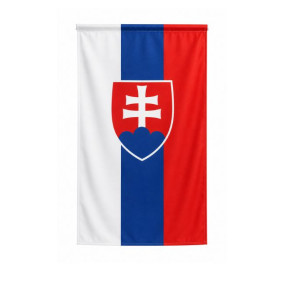
Flag of the Slovak Republic with a tunnel 60 x 90 cm
Flag of the Slovak Republic with a tunnel, made from high-quality PES flag fabric, available in sizes from 60 x 90 cm to 150 x 300 cm.
32,54 €
(40,02 incl. VAT)
Product detail● Regularly in stock
Flags of the Slovak Republic with tunnels in various sizes and designs. Quality materials and precise workmanship for every occasion.
Flag of the Slovak Republic with a tunnel, made from high-quality PES flag fabric, available in sizes from 60 x 90 cm to 150 x 300 cm.
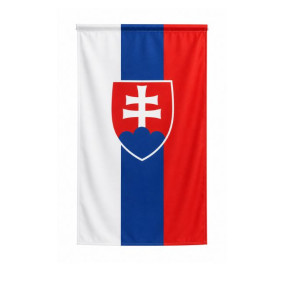
The flag of the Slovak Republic with a tunnel, 80 x 120 cm, made of durable and high-quality PES fabric, ideal for outdoor use.
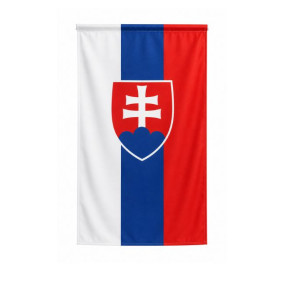
The flag of the Slovak Republic with tunnel 100 x 150 cm, made of PES flag fabric with double stitching for increased durability.
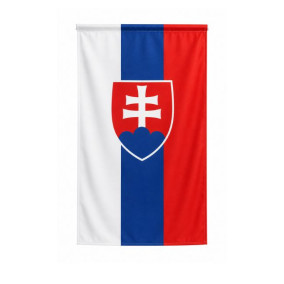
Flag of the Slovak Republic with tunnel 100 x 200 cm, made from PES flag fabric, edged with double stitching for greater durability.
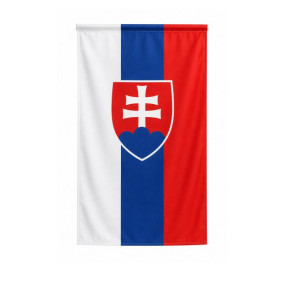
Flag of the Slovak Republic measuring 150 x 225 cm, made of polyester flag fabric, durable and of high quality. Ideal for outdoor use.
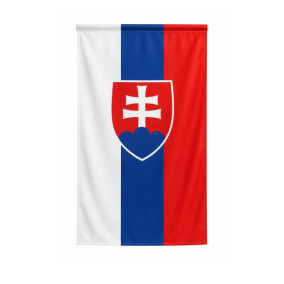
Flag of the Slovak Republic with a tunnel 100 x 300 cm, made of PES flag fabric, durable and high-quality with double stitching.
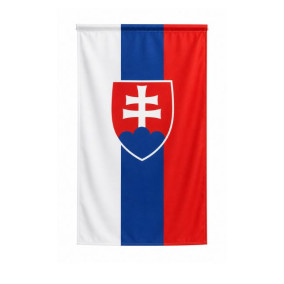
Flag of the Slovak Republic with a tunnel, 150 x 300 cm, made from PES flag fabric with high-quality printing and double stitching.

The flag of the Slovak Republic with a tunnel is designed for attachment using a pole or rod threaded through a tunnel created on the shorter side of the fabric. This method of attachment is one of the most commonly used for facade holders, ceremonial poles, and representative systems placed in front of buildings or indoors.
Unlike flags with carabiners, which are intended for poles with a rope mechanism, the tunnel design creates a secure connection between the flag and the supporting pole. The result is a more stable attachment and a representative appearance without visible fastening elements.
The flag is made using dispersion printing and reinforced with a double stitch around the entire perimeter. This combination ensures good color fastness and higher resistance to mechanical stress during long-term use.
The tunnel is a textile sleeve created on the shorter side of the flag. The supporting pole is inserted into it, ensuring an even distribution of weight across the entire width of the attachment.
This solution is used wherever the flag needs to be firmly stretched and aesthetically presented. It is most commonly seen at entrances to public buildings, company headquarters, schools, cultural institutions, or venues for official events.
A practical advantage of the tunnel is the absence of movable connecting elements. This eliminates wear on carabiners and the risk of damage during frequent handling.
The size of the flag should correspond to the length of the supporting pole, the size of the building, and the distance from which it will be visible. Smaller dimensions are used for indoor and occasional applications, while larger formats are intended for representative outdoor use.
The size 100 × 150 cm represents a balanced ratio between visibility, weight, and load on the supporting system. It is sufficiently prominent on ordinary buildings while not requiring robust structural solutions.
This format is most commonly used on facade holders with arms approximately 170 cm long, which are standard for administrative buildings and public institutions.
The lifespan of the flag is influenced not only by the quality of printing or sewing. The location of the building, wind intensity, orientation to the sun, and frequency of use are also significant factors.
In open spaces, there is significantly higher mechanical stress than in urban environments protected by surrounding buildings. Therefore, two identical flags used in different conditions can have markedly different lifespans.
Double stitching is one of the details that helps extend the lifespan of the most stressed parts. The edges are often where the first signs of wear appear.
A flag attached to a pole appears more stable and representative, especially on building facades. It is suitable where the national symbol needs to be constantly visible and aesthetically arranged.
For public institutions, schools, local governments, or corporate headquarters, it is a proven way to present national affiliation without the need to build separate poles. The correctly chosen size and quality of attachment influence the final appearance more than the size of the flag itself.