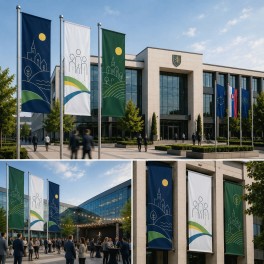
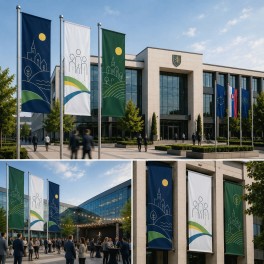
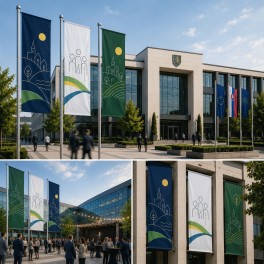
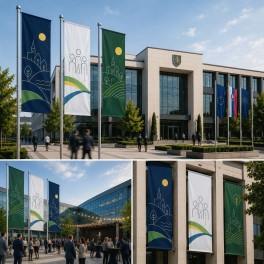
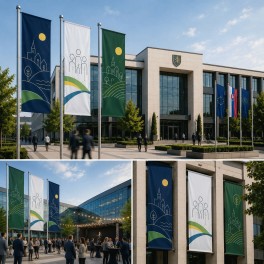
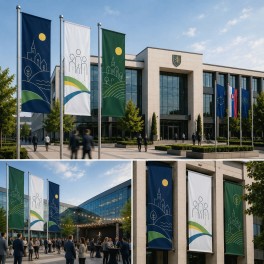
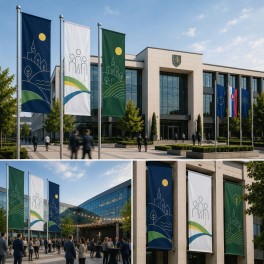
Quality municipal and city flags with a tunnel for every occasion. A wide selection, various sizes and designs in one place.
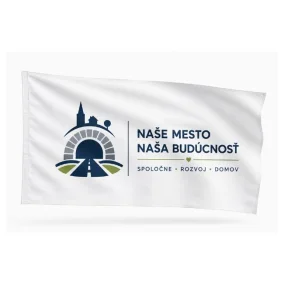
Municipal and city flags with a sleeve: a secure attachment to the pole that maintains its shape even with long-term use
A flag with a sleeve is one of the cleanest and most stable solutions for representing municipalities and cities both indoors and on solid poles. Its foundation is a textile sleeve along the edge, which is threaded directly onto the supporting rod and keeps the flag in a precisely defined position without the need for visible attachment elements.
What exactly does sleeve attachment mean
The sleeve is a reinforced folded edge of the fabric that creates space for the pole or rod. In practice, it is a simple mechanical principle, but its processing determines how long the flag will last without deformation or seam damage.
With quality execution, the sleeve is reinforced with multiple stitches and tailored to the diameter of the supporting pole so that the flag does not fall, twist, and can be comfortably put on and taken off.
Where are flags with sleeves most commonly used
In practice, they are most commonly used in the interiors of municipal and city offices, ceremonial halls, meeting rooms, and representative spaces. A stable attachment without moving parts is advantageous where the flag is meant to appear dignified and is not exposed to wind.
They are also often used at ceremonial occasions where visual accuracy is important – for example, during inaugurations, memorial events, or official receptions of delegations.
Material and construction determine how the flag will look after years
Polyester flag fabric with a weight of approximately 110 to 160 g/m² is most commonly used. Not only the thickness of the material is important, but also its ability to maintain shape without wrinkling and transparency.
The sleeve is a critical part of the entire flag because it bears the entire weight of the fabric along one line. If it is not properly reinforced, gradual stretching or deformation of the edge occurs.
- reinforced sleeve with multiple stitching,
- precisely tailored to the diameter of the pole,
- colorfast printing suitable for long-term use,
- resistance to mechanical stress at a single point,
- preservation of the exact proportions of the coat of arms or symbol.
Why sleeve attachment is different from carabiners or eyelets
The sleeve creates a static attachment without movement at the point of contact with the pole. This means less mechanical wear, but at the same time, a higher load on one specific seam.
Unlike carabiners, which distribute force across multiple points, the sleeve concentrates the load into one line. Therefore, the quality of stitching and precision of processing are crucial for longevity.
In practice, the sleeve is used where a representative appearance without visible metal or plastic elements is important.
How to properly choose a flag with a sleeve
The most important technical parameter is the diameter of the pole. A sleeve that is too tight complicates handling, while one that is too loose causes the flag to twist and lose its stable position.
Equally important is whether the flag will be used exclusively indoors or occasionally moved outside. For outdoor use, a combination of reinforcement and more durable fabric is often addressed, although the sleeve remains the main attachment.
Why municipalities address the sleeve in the design
In practice, it has been shown that an incorrectly chosen sleeve often causes problems with handling and longevity. Therefore, municipalities and cities address the exact dimensions, type of pole, and method of use already at the time of ordering.
An important factor is also consistency – in repeated productions, the flag must fit the same stands even after years, without differences in processing or sleeve width.