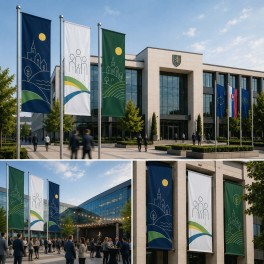
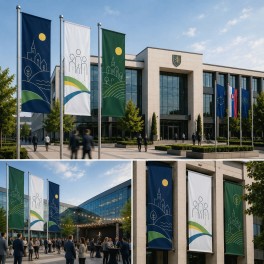
Municipal and city flags with carabiners and a tunnel, ideal for any occasion. Quality and variety for your needs.
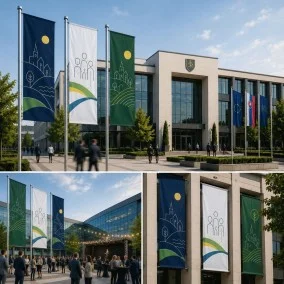
Municipal and city flags with carabiners and tunnel: a universal solution for outdoor and indoor representation
A flag that combines a tunnel and carabiners is designed to function in two different situations – stable attachment to a pole and flexible attachment to a rope mast. In practice, this is the most versatile design used where the flag is moved between indoor and outdoor settings or where multiple attachment methods are required without changing the fabric.
What the combination of tunnel and carabiners means
The tunnel is used to slide the flag onto a pole or support rod, while the carabiners allow attachment to the mast's rope system. Both solutions are integrated into one flag, with their placement designed to not restrict each other.
In practice, this means that one flag can be used in a ceremonial hall and also on an outdoor mast without the need for further modification or production of another version.
Where such flags are most commonly used
They are most commonly used by municipalities and cities that need a unified visual symbol for multiple environments. Typically, this involves a combination of indoor representations (meetings, weddings, ceremonial rooms) and outdoor masts in front of the office building.
They are also often used in city partnerships, where flags are moved between different locations and flexibility is needed without interfering with the structure.
Material and reinforcement determine how long it lasts
Since it is a combined attachment, the flag is subjected to more stress at various points. The tunnel must withstand friction on the pole, while the carabiners transfer the pull in the wind. Therefore, polyester fibers with higher durability and a weight of approximately 110 to 160 g/m² are used.
A critical point is the transition between the attachment systems. If not properly reinforced, it can lead to deformation or premature damage to the material.
- reinforced tunnel with multiple stitching,
- reinforced points for carabiners against tearing,
- UV stable and colorfast printing,
- resistance to wind and mechanical stress,
- precise preservation of proportions and colors of the symbol.
Why the combination of attachments is not just "two in one"
At first glance, it seems to be a simple connection of two systems, but in practice, the distribution of weight and the type of stress are crucial. The tunnel operates with a different type of movement than the carabiners, so the stitching must be designed to prevent the material from twisting and creating tension in a single line.
A common mistake in cheaper solutions is the same reinforcement of the entire edge regardless of the type of attachment, leading to uneven wear.
How to choose the right combined design
When ordering, it is important to specify exactly where the flag will be used most frequently. If the outdoor use predominates, the carabiners play a dominant role. If it is for indoor use, the quality of the tunnel and its diameter are decisive.
One of the less obvious decision factors is the orientation of the graphics in both attachment methods. The flag must be readable correctly in both positions, which affects the design already in the production stage.
In practice, the archiving of production parameters is also addressed to enable the later production of an identical flag without differences in shades or stitching.
Why municipalities address this in one specification
Combined flags simplify logistics and reduce the need for multiple variants of the same symbol. Cities and municipalities do not have to store separate versions for indoor and outdoor use, which simplifies management and handling.
In the long term, consistency of appearance at public events is also important, where both systems are often used simultaneously.