Municipal and city flags with carabiners for various occasions. Quality materials, a wide selection of designs and sizes all in one place.
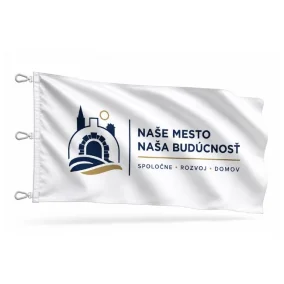
Municipal and city flags with carabiners: when quick handling and secure attachment in the wind matter
A flag with carabiners is one of the most practical solutions for outdoor use, especially where flags are regularly changed or exposed to stronger winds. Carabiners allow for quick and secure attachment to the ropes on the flagpole, keeping the flag stable and less prone to twisting.
What the carabiner setup means in practice
Carabiners are metal or reinforced plastic attachments that are fixed to the edge of the flag and then connected to the rope system of the flagpole. The placement of the carabiners determines how the flag behaves in the wind and how evenly the load is distributed.
Unlike a sleeve, where the flag is mounted on the pole, carabiners allow for freer movement of the flag, which is advantageous for outdoor use and frequent flag changes.
Where flags with carabiners are most commonly used
They are most commonly found on flagpoles in front of municipal and city offices, in squares, near cultural centers, or sports facilities. They are also used during national holidays, international events, and for changing flags according to current occasions.
In practice, they are popular where a flag lowering system using a rope is employed, as they allow for quick changes without the need to dismantle the entire structure.
Material and reinforcement determine longevity
Outdoor flags with carabiners must withstand constant wind, UV radiation, and mechanical stress at the attachment points. Therefore, polyester fabrics with a weight of approximately 110 to 160 g/m² are most commonly used.
A key element is the reinforced edge with double or triple stitching, as the greatest tension occurs at the carabiner points. In cheaper versions, material tearing often occurs at these points.
- reinforced carabiner attachment against tearing,
- UV stable and colorfast printing,
- resistance to wind and moisture,
- even distribution of load along the edge of the flag,
- accurate preservation of the colors of the official symbol.
How to properly choose the number and placement of carabiners
The number of carabiners depends on the height of the flag and the type of flagpole. For smaller formats, two attachments are sufficient, while larger ones use more points to prevent twisting and uneven loading.
The placement directly affects how the flag behaves in strong winds. Too few points cause material overload, while optimal distribution extends the lifespan of the entire flag.
The difference compared to sleeves and other attachment systems
A flag with carabiners is more flexible for changes and suitable for outdoor use, while a sleeve is more commonly used for indoor or fixed poles. Grommets represent a compromise solution but do not provide the same level of stability in strong winds.
The choice of system often depends on how frequently the flags are changed and whether it is for representation at one location or for dynamic use throughout the year.
Why local governments address this detail during design
In practice, it turns out that an improperly chosen attachment system leads to faster wear of the flag. Therefore, local governments often consider not only the graphics but also technical parameters such as the type of carabiners, their material, and the stitching method when placing an order.
Well-designed attachments reduce the need for frequent replacements and ensure that the flag remains stable even when exposed to outdoor conditions for extended periods.